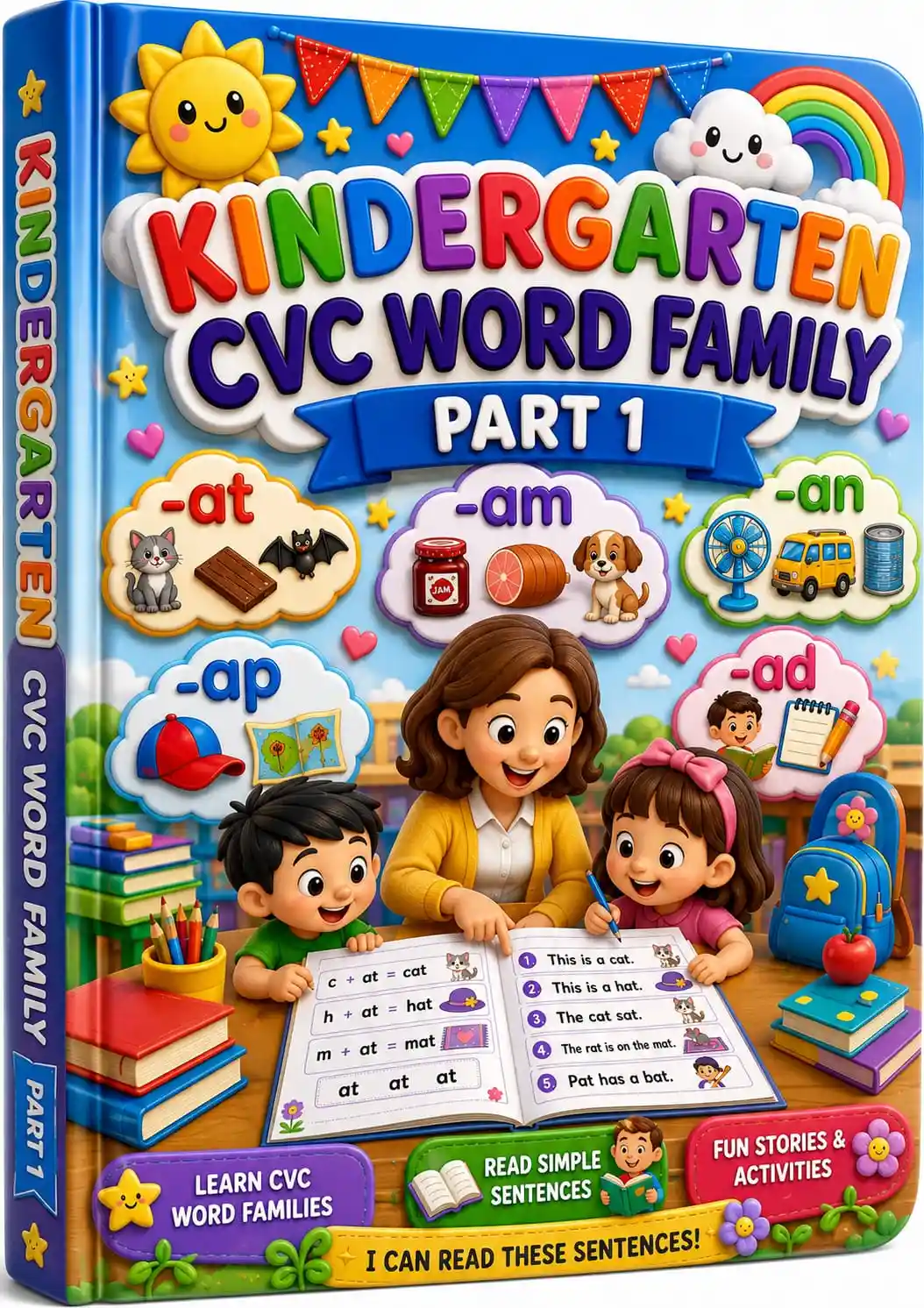
Kindergarten CVC Word Family Part 1 – A Fun Start to Early Reading
Kindergarten CVC Word Family Part 1 is a useful early literacy resource for young learners who are beginning to understand how letters and sounds work together. CVC words are simple three-letter words made with a consonant, vowel, and consonant, such as cat, bed, pig, dog, and sun. Learning these patterns can help children develop early reading, spelling, and phonics skills.
What Are CVC Word Families?
CVC word families are groups of words that share a common ending sound or letter pattern. For example, the -at family includes words such as cat, bat, hat, and mat. Once children understand the pattern, they can use it to read several new words.
Kindergarten CVC Word Family Part 1 can introduce children to these simple patterns through repeated practice and familiar vocabulary.
Build Letter-Sound Recognition
Before children can read CVC words independently, they need to recognize basic letter sounds. Activities that connect letters with sounds can help strengthen this foundation.
For example, children can practice identifying the sounds in m-a-t and then blend them together to read “mat.” Repeating this process with different words helps learners understand how individual sounds combine to create words.
Practice Common Word Families
Simple word families can make reading feel more predictable. Kindergarten learners may practice patterns such as:
- -at: cat, bat, hat, mat
- -an: fan, man, can, pan
- -it: sit, fit, hit, bit
- -og: dog, log, fog, jog
- -ug: bug, mug, rug, hug
These patterns allow children to change one letter and discover a new word.
Improve Reading and Spelling
CVC word families support both reading and spelling. Children can sound out a word, identify each individual sound, and write the letters that represent those sounds.
The Kindergarten CVC Word Family Part 1 approach can also encourage learners to read words in short sentences. For example, after learning “cat,” “sat,” and “mat,” children can practice reading, “The cat sat on the mat.”
Make Phonics Practice Fun
Young children often respond well to activities that feel like games. Parents and teachers can use word-family cards, matching games, picture clues, tracing exercises, and word-building activities.
Ask children to find objects or pictures that match a particular word family. This adds movement and interaction to phonics practice while reinforcing new vocabulary.
Create a Short Daily Routine
Consistent practice can help children remember phonics patterns. A 10–15-minute routine might include reviewing letter sounds, reading a word family, building new words, and reading a few simple sentences.
Using Kindergarten CVC Word Family Part 1 regularly can give children repeated opportunities to practice without making lessons feel overwhelming.
Final Thoughts
Kindergarten CVC Word Family Part 1 can be a helpful resource for introducing young learners to simple word patterns and early reading skills. By combining phonics, blending, spelling, vocabulary, and sentence practice, children can develop a stronger foundation for independent reading.
With encouragement, repetition, and playful activities, kindergarten learners can discover that learning to read is both achievable and fun.