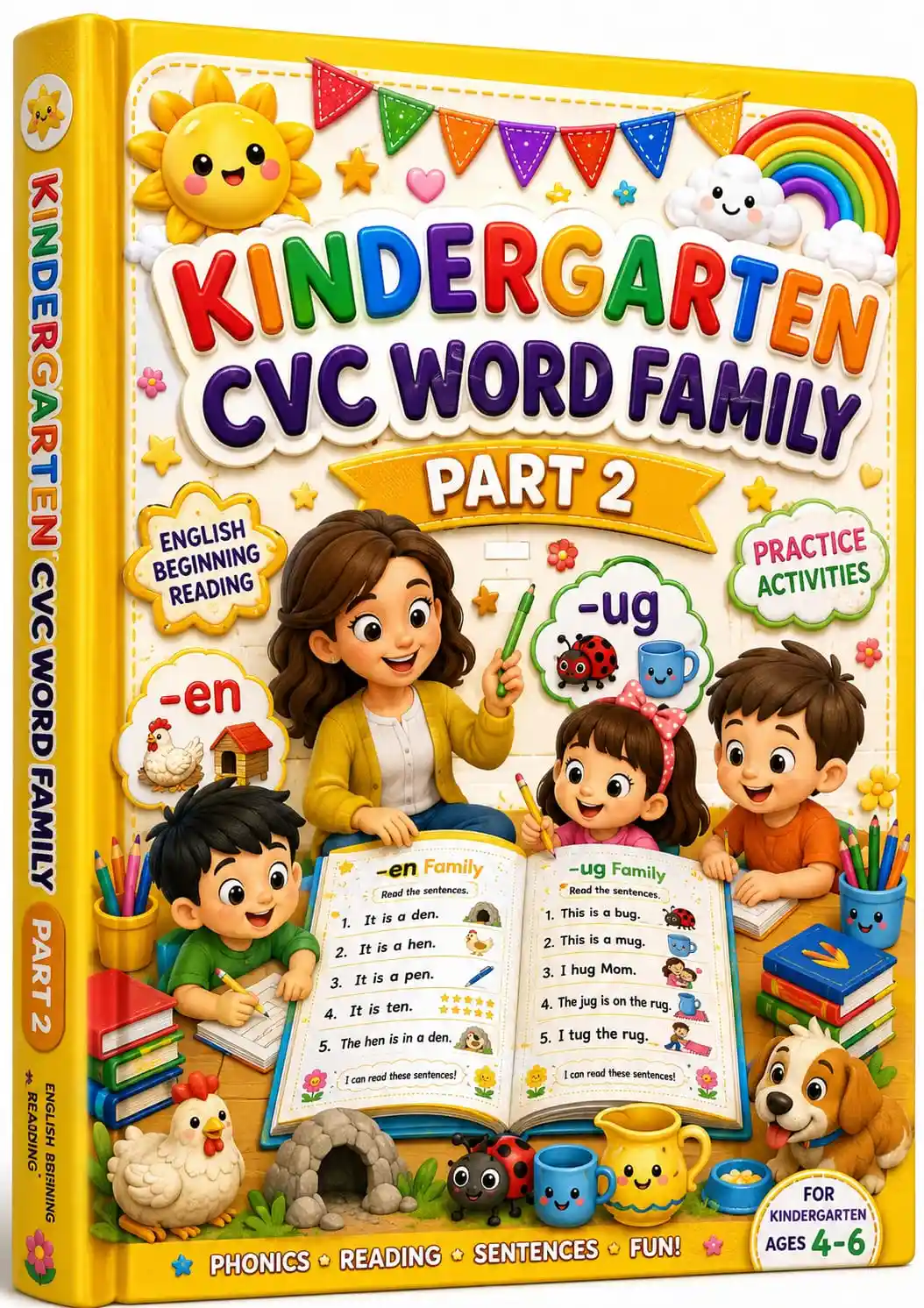
Kindergarten CVC Word Family Part 2 – Strengthen Early Reading Skills
Kindergarten CVC Word Family Part 2 is a useful early literacy resource for children who are ready to continue developing their phonics, reading, spelling, and vocabulary skills. After learning basic letter sounds and simple CVC patterns, children can build confidence by practicing additional word families and discovering how changing one letter can create a completely new word.
What Are CVC Word Families?
CVC stands for Consonant-Vowel-Consonant. Words such as map, hen, sit, log, and cup follow this simple pattern. Word families group words that share similar spelling and sound patterns.
For example, the -ap family includes words such as cap, map, tap, and nap. Learning these patterns helps children recognize similarities between words instead of treating every word as completely new.
Build on Previous Phonics Skills
Kindergarten CVC Word Family Part 2 can help learners move beyond their first word-family patterns. Children can review familiar sounds while practicing new combinations.
Encourage children to say each sound separately and then blend the sounds together. For example:
c – a – p → cap
After mastering the word, ask children to change the beginning sound:
cap → map → tap → nap
This simple activity demonstrates how letters and sounds work together.
Practice More Word Families
Children can explore a variety of short-vowel patterns, including:
- -ap: cap, map, tap, nap
- -et: pet, jet, net, wet
- -ip: lip, dip, sip, tip
- -op: hop, mop, top, cop
- -ub: cub, tub, rub, sub
Practicing several families helps children become more flexible when decoding unfamiliar words.
Improve Reading and Spelling
CVC word families are valuable for both reading and spelling. Once children can recognize a pattern, they can use their phonics knowledge to write related words.
The Kindergarten CVC Word Family Part 2 approach can also include simple sentences. For example, after learning hop, top, and mop, children can read a sentence such as, “The dog can hop.”
Connecting individual words to sentences helps children understand that phonics is a tool for meaningful reading.
Make Learning Interactive
Kindergarten learners often benefit from hands-on activities. Parents and teachers can use letter tiles, picture cards, matching games, tracing exercises, and word-building challenges.
Ask children to create as many words as possible from one word family. They can then read each word aloud and draw a picture for one of them.
Create a Daily Practice Routine
A short 10–15-minute lesson can provide effective practice without overwhelming young learners. Begin with a quick review of letter sounds, introduce one word family, blend several words, and finish by reading simple sentences.
Using Kindergarten CVC Word Family Part 2 consistently can help reinforce previously learned phonics skills while introducing new patterns.
Final Thoughts
Kindergarten CVC Word Family Part 2 can be a valuable resource for children who are continuing their early reading journey. Through word-family practice, blending, spelling, sentence reading, and playful activities, young learners can develop stronger phonics foundations.
With regular practice and encouragement, children can become more confident at recognizing patterns, decoding new words, and enjoying the process of learning to read.