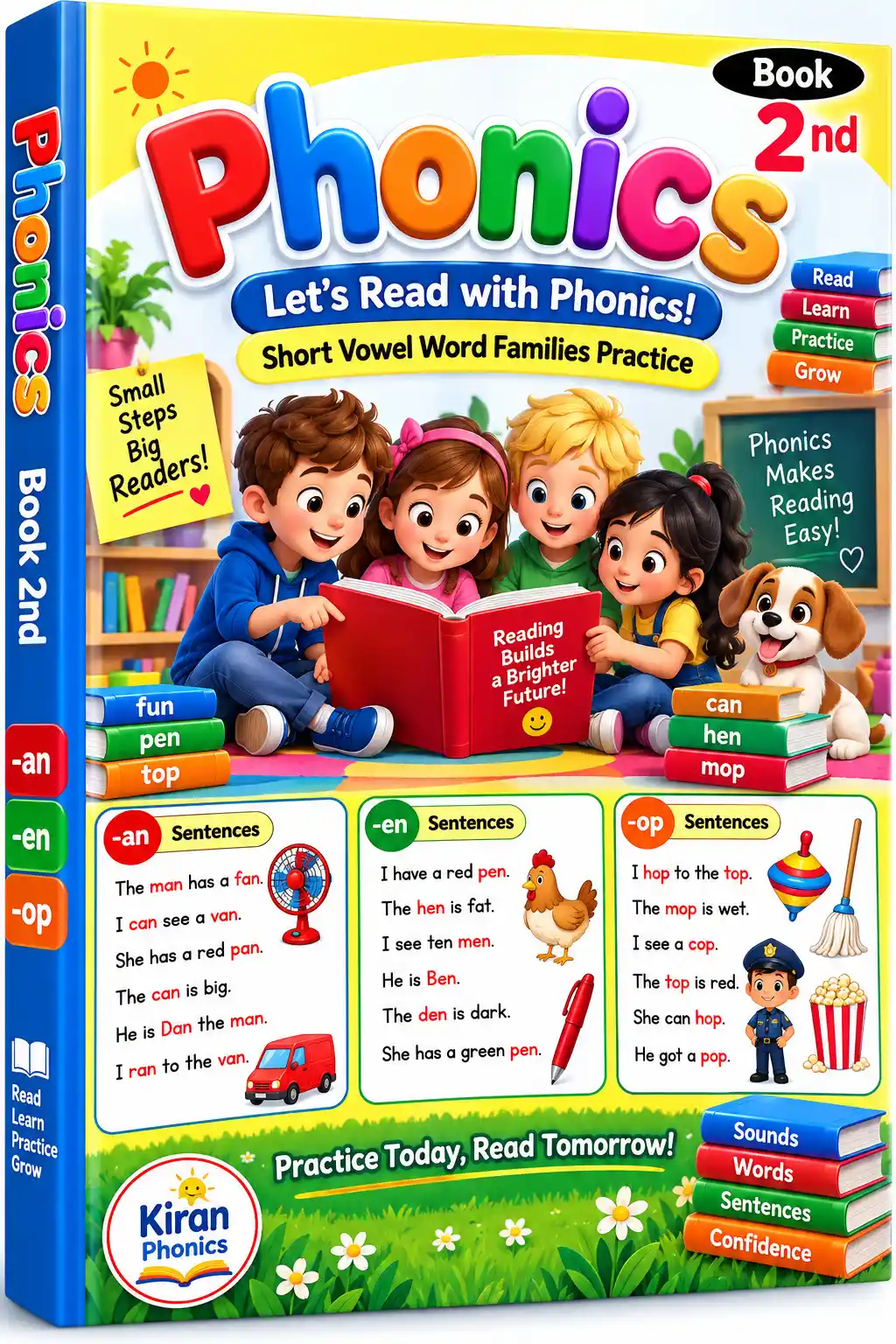
Phonics Book 2 , Phonics Word Families Practice Sentences – Build Strong Early Reading Skills
Phonics Book 2 , Phonics Word Families Practice Sentences is a useful early-reading resource designed to help children strengthen phonics, recognize word families, and develop confidence with simple sentences. Word-family practice gives young learners an opportunity to notice common spelling patterns and use those patterns when reading new words. FIMS Teaching Resources lists this title among its phonics and children’s learning resources, alongside materials focused on word families, CVC words, reading fluency, and short vowels.
Strengthen Word-Family Recognition
Word families are groups of words that share a common ending and sound pattern. For example, children may practice groups such as -at, -an, -it, or -op. Once learners recognize a familiar pattern, they can use it to decode several related words instead of memorizing each word separately.
Phonics Book 2 , Phonics Word Families Practice Sentences can make this process more structured by combining word-pattern practice with reading activities. This approach helps children connect individual sounds with complete words and gradually become more independent readers.
Practice Short Vowel Patterns
Short vowels are an important part of early phonics instruction. Children need repeated opportunities to hear, identify, blend, and read short-vowel words. Word families can make this practice easier because the repeated ending gives learners a predictable pattern to follow.
Through regular activities, children can practice distinguishing vowel sounds while reading simple words. This can support both decoding and spelling development and prepare learners for more advanced phonics patterns.
Move From Words to Sentences
One of the most valuable features of Phonics Book 2 , Phonics Word Families Practice Sentences is the connection between isolated word practice and sentence reading. Children need to see phonics patterns used in meaningful contexts, not only as individual word lists.
Simple sentences allow learners to apply their decoding skills while also building reading fluency. As children read familiar patterns repeatedly, they can begin to recognize words more quickly and focus more attention on understanding what they read.
Improve Reading Confidence
Consistent phonics practice can help children feel more comfortable when they encounter unfamiliar words. Instead of immediately relying on guessing, learners can look at the letters, identify familiar patterns, blend the sounds, and attempt the word.
Phonics Book 2 , Phonics Word Families Practice Sentences can therefore be useful for parents, teachers, tutors, and homeschool educators looking for structured early-reading practice. Related FIMS resources also include phonics word families, reading fluency, CVC sentences, and other beginner reading materials.
Create a Simple Daily Routine
For effective results, parents and teachers can use Phonics Book 2 , Phonics Word Families Practice Sentences for short, regular sessions. A 10–15 minute routine might include reviewing sounds, reading a word family, blending new words, and finishing with a few simple sentences.
Final Thoughts
Phonics Book 2 , Phonics Word Families Practice Sentences provides a practical way to connect phonics patterns, word recognition, and sentence reading. With consistent practice, children can strengthen decoding, spelling, fluency, vocabulary, and reading confidence while developing a stronger foundation for future literacy success.