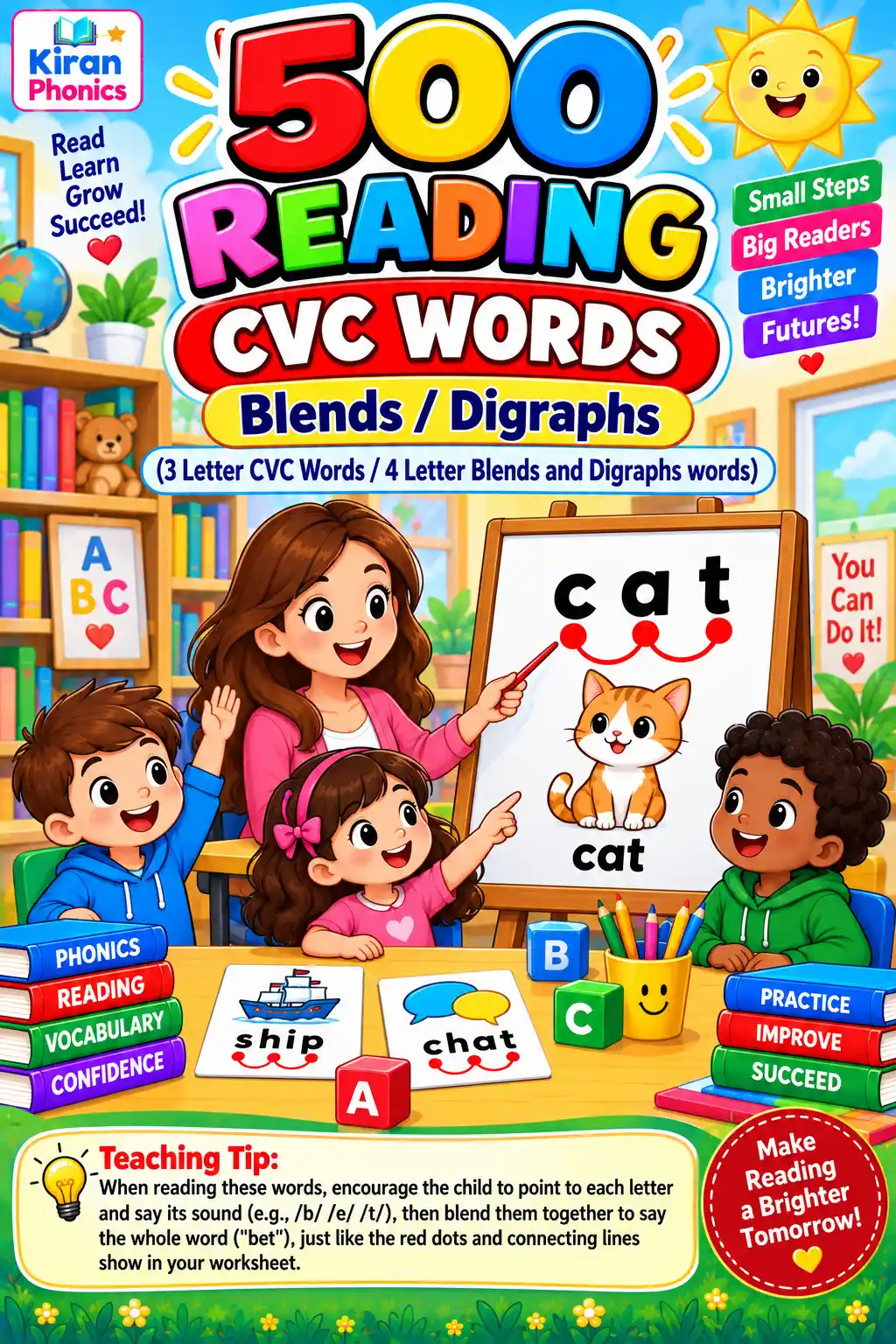
500 READING CVC WORDS Blends Digraphs – Build Strong Phonics and Reading Skills
500 READING CVC WORDS Blends Digraphs is a valuable phonics practice resource for young learners who are developing foundational reading and decoding skills. CVC words, consonant blends, and digraphs are important building blocks for early literacy because they help children connect letters with sounds and combine those sounds to read words. Structured phonics practice can help learners become more accurate and confident readers.
Build a Strong CVC Word Foundation
CVC words follow a simple consonant-vowel-consonant pattern, such as cat, bed, pig, hot, and sun. These words are especially useful for beginning readers because children can practice identifying the initial, middle, and final sounds.
500 READING CVC WORDS Blends Digraphs gives learners extensive opportunities to practice reading these patterns. Repeated exposure helps children recognize common word structures and gradually move from sounding out each letter to reading familiar words more automatically.
Practice Consonant Blends
Once children are comfortable with basic CVC words, consonant blends provide the next step in phonics development. Blends occur when two or more consonants appear together while each sound remains recognizable, such as bl, st, gr, or cl.
Regular practice with blends helps children develop stronger decoding skills. They learn to look carefully at groups of letters, pronounce the individual sounds, and blend them smoothly into a complete word.
Learn Common Digraphs
Digraphs are another important phonics skill. Common examples include sh, ch, th, and wh, where two letters work together to represent a sound or sound combination. 500 READING CVC WORDS Blends Digraphs can help learners become familiar with these patterns through repeated word-reading practice.
Resources that combine CVC words, blends, and digraphs can give children a logical progression from simpler sound patterns to more advanced decoding.
Improve Reading Fluency
Phonics practice becomes even more useful when children apply their skills to connected reading. After practicing individual words, parents and teachers can ask learners to read short sentences containing familiar CVC words, blends, and digraphs.
This helps children transfer decoding skills into real reading. Repeated reading can also improve accuracy, speed, confidence, and expression. 500 READING CVC WORDS Blends Digraphs can therefore complement classroom instruction, literacy centers, tutoring sessions, homework, and homeschool activities.
Make Daily Practice Effective
A short daily routine can produce meaningful progress. Begin by reviewing several CVC words, move to a few blend and digraph words, and finish by reading simple sentences. Encourage children to sound out unfamiliar words rather than immediately guessing from pictures.
Teachers can also group words by patterns so learners notice similarities between words and strengthen their phonics awareness.
Final Thoughts
500 READING CVC WORDS Blends Digraphs provides a structured way to practice essential early-reading patterns. By working through CVC words, consonant blends, and digraphs, children can strengthen sound recognition, decoding, spelling, vocabulary, and reading fluency. With consistent practice, 500 READING CVC WORDS Blends Digraphs can help young learners build the confidence they need to become stronger, more independent readers.